Crypto Casino KYC: When Is Identity Verification Required?
Crypto casino KYC helps operators verify player identities, prevent fraud and meet regulatory requirements. Learn when identity checks are required, which documents may be requested, how the verification process works, and why policies differ between casinos and jurisdictions.
Crypto casino KYC is an important part of using many online cryptocurrency casinos. Although some platforms allow users to register and make an initial deposit with only an email address or crypto wallet, identity verification may still be required before withdrawals, after certain transactions, or when additional security checks are triggered.
KYC stands for Know Your Customer. It is a process used to confirm a customer's identity and help prevent fraud, money laundering, underage gambling, and other illegal activity.
But when exactly do crypto casinos ask for identification? Which documents might be required? And why can two platforms have completely different verification policies?
This guide explains how crypto casino KYC works, what to expect during verification, and what to check before choosing a platform.
1. What Is KYC in a Crypto Casino?
KYC (Know Your Customer) is an identity verification process used by financial services and gambling operators to establish who their customers are.
In a crypto casino, the process may involve collecting personal details, checking identity documents, confirming an address, and reviewing certain transactions.
The main purposes of KYC include:
- Identity verification: Confirming that an account belongs to a real person.
- Fraud prevention: Reducing identity theft, fake accounts, and account misuse.
- Anti-money laundering (AML): Helping identify transactions that may involve criminal funds.
- Age verification: Checking that customers meet the legal gambling age.
- Regulatory compliance: Meeting the requirements of the operator's licensing jurisdiction.
KYC and AML are closely connected, but they are not the same thing. KYC focuses on identifying and understanding the customer, while AML covers the wider policies and controls used to detect and prevent money laundering.
It is also important to understand that cryptocurrency does not automatically remove the need for identity checks. Blockchain transactions may use wallet addresses rather than traditional bank account details, but regulated operators can still have legal obligations to identify customers and review transactions.
2. When Is KYC Required at a Crypto Casino?
There is no single verification rule followed by every crypto casino. Some operators request identity documents during registration, while others allow limited account activity before requesting additional information.
Common situations that may trigger KYC include:
Before the First Withdrawal
One of the most common situations is a withdrawal request.
A casino may allow a player to create an account and deposit cryptocurrency before asking for identity documents. However, when the player requests a payout, the operator may require verification before releasing the funds.
This is why it is important to read the withdrawal and verification policies before depositing.
When Deposits or Withdrawals Reach Certain Levels
Some operators apply transaction limits or internal risk thresholds. When account activity reaches a particular level, additional checks may be required.
These thresholds are not universal. They may depend on local legislation, the casino's licence, its payment systems, and its internal risk assessment.
Importantly, splitting a large transaction into smaller transfers does not guarantee that verification can be avoided. Operators may review connected transactions and unusual activity.
When Unusual Account Activity Is Detected
A casino may request additional information if its monitoring systems identify activity that needs further review.
Examples include:
- Deposits or withdrawals that differ significantly from previous activity.
- Transactions that appear inconsistent with the customer's financial profile.
- Multiple payment methods or wallets that require clarification.
- Account access patterns that suggest possible account sharing or unauthorised access.
- Information that does not match previously submitted documents.
An additional check does not automatically mean that a player has done something wrong. It may simply be part of the operator's security and compliance procedures.
When Local Regulations Require It
Some jurisdictions require gambling operators to identify and verify customers before allowing them to gamble. Other legal frameworks allow certain checks to take place at different stages, depending on the activity and applicable risk rules.
For example, UK Gambling Commission guidance requires remote gambling operators to establish and verify customer identity before customers are permitted to gamble. Other jurisdictions may apply different requirements.
The rules that matter are those applicable to the operator's licence and the player's location.
3. What Documents Are Usually Required?
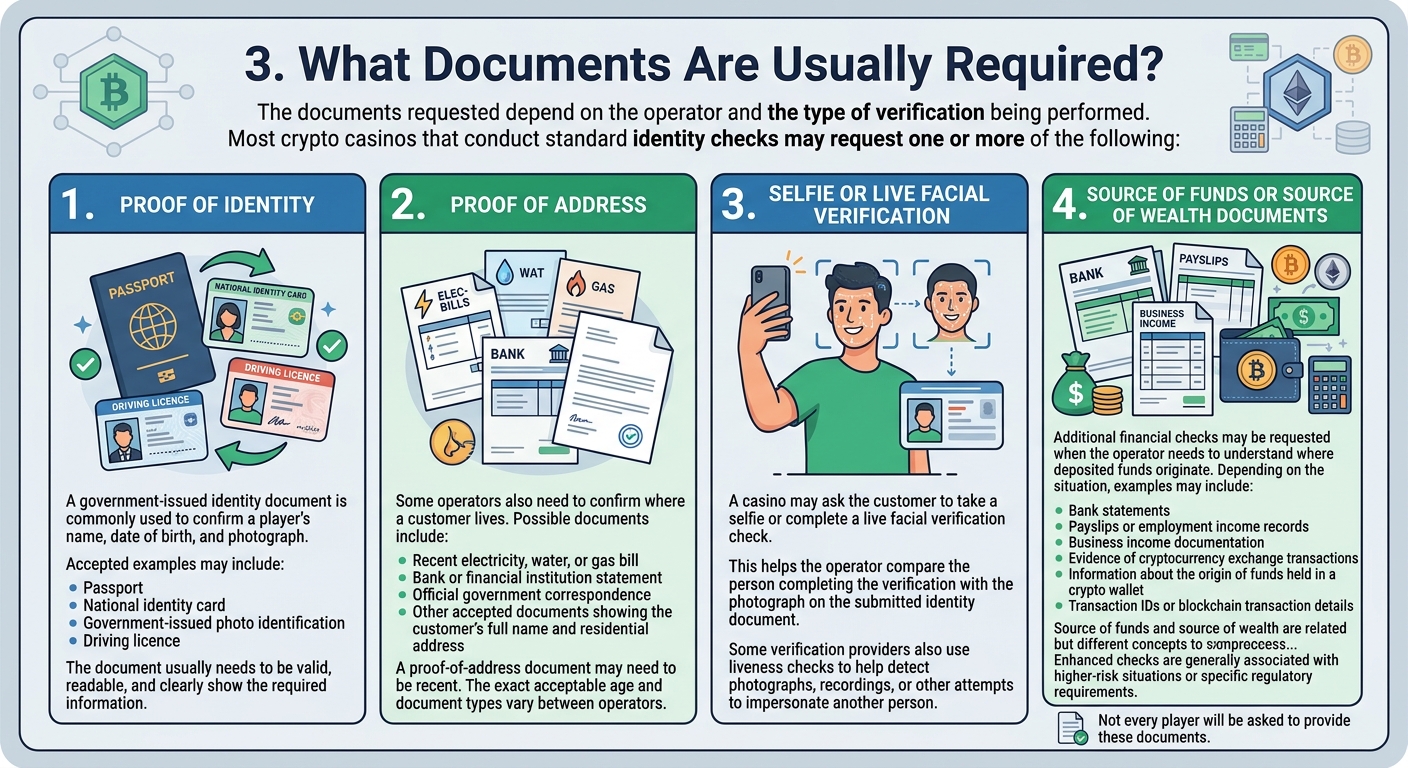
The documents requested depend on the operator and the type of verification being performed.
Most crypto casinos that conduct standard identity checks may request one or more of the following:
Proof of Identity
A government-issued identity document is commonly used to confirm a player's name, date of birth, and photograph.
Accepted examples may include:
- Passport.
- National identity card.
- Government-issued photo identification.
- Driving licence.
The document usually needs to be valid, readable, and clearly show the required information.
Proof of Address
Some operators also need to confirm where a customer lives.
Possible documents include:
- Recent electricity, water, or gas bill.
- Bank or financial institution statement.
- Official government correspondence.
- Other accepted documents showing the customer's full name and residential address.
A proof-of-address document may need to be recent. The exact acceptable age and document types vary between operators.
Selfie or Live Facial Verification
A casino may ask the customer to take a selfie or complete a live facial verification check.
This helps the operator compare the person completing the verification with the photograph on the submitted identity document.
Some verification providers also use liveness checks to help detect photographs, recordings, or other attempts to impersonate another person.
Source of Funds or Source of Wealth Documents
Additional financial checks may be requested when the operator needs to understand where deposited funds originate.
Depending on the situation, examples may include:
- Bank statements.
- Payslips or employment income records.
- Business income documentation.
- Evidence of cryptocurrency exchange transactions.
- Information about the origin of funds held in a crypto wallet.
- Transaction IDs or blockchain transaction details.
Source of funds and source of wealth are related but different concepts. Source of funds concerns the origin of the money used in a particular transaction. Source of wealth concerns how a person accumulated their overall wealth.
Not every player will be asked to provide these documents. Enhanced checks are generally associated with higher-risk situations or specific regulatory requirements.
4. How Does the Crypto Casino KYC Process Work?
Although verification systems differ, the process usually follows a similar sequence.
Step 1: Open an Account
The player registers with the casino and provides basic details, such as their name, date of birth, email address, and country of residence.
Some platforms collect more information during registration, depending on their compliance requirements.
Step 2: Submit Identity Documents
If verification is required, the player uploads the requested documents through the casino's account verification page or an authorised verification provider.
Images should be clear, complete, and unedited. Blurry photographs, missing document corners, or inconsistent details may delay the review.
Step 3: Complete Additional Checks
The casino may ask for a selfie, a live facial check, proof of address, or further information.
If the operator needs to understand a particular deposit or withdrawal, it may also request supporting financial or transaction records.
Step 4: Wait for Review
The submitted information is checked against the operator's verification requirements.
Some automated checks can be completed quickly, while manual reviews may take longer. There is no universal processing time.
Step 5: Receive the Verification Result
Once the review is complete, the casino may approve the account, request additional information, or explain that verification could not be completed.
Players should check their account dashboard and official support messages for updates.
5. Why Do KYC Requirements Differ Between Crypto Casinos?
It is common to see different verification policies across crypto gambling platforms. There are several reasons for this.
Licensing Jurisdiction
The country or jurisdiction in which a casino is licensed can significantly influence its verification obligations.
Regulators may establish different rules regarding customer identification, transaction monitoring, age checks, and anti-money laundering controls.
For example, UK-licensed operators must follow requirements set by the UK Gambling Commission. Operators licensed elsewhere may be subject to different local laws and supervisory authorities.
A casino's website being accessible from a country does not necessarily mean that it is authorised to offer gambling services there.
Operator Risk Policies
Regulations are only one part of the picture. Casinos also establish internal compliance policies based on their business model, payment methods, customer activity, and risk exposure.
One operator may verify every customer before the first deposit. Another may use a risk-based approach and request additional documents only when necessary.
A lighter registration process does not necessarily mean that an operator will never request KYC later.
Cryptocurrency and Payment Methods
Crypto casinos may accept Bitcoin, Ethereum, stablecoins, and other digital assets. Different payment methods can introduce different verification and transaction-monitoring considerations.
For example, an operator may review the origin of funds, wallet activity, or the relationship between a customer's account and a particular transaction.
Blockchain transparency can help trace transaction histories, but a wallet address alone does not establish the identity of the person controlling it.
Customer Activity and Risk Level
Verification requirements may increase when a customer's activity creates additional compliance concerns.
A player making occasional small deposits may experience a different verification process from someone making large or unusual transactions.
This does not mean that every large transaction is suspicious. It means that operators may need to apply additional checks when required by their policies or applicable law.
6. KYC, AML and Enhanced Due Diligence: What Is the Difference?
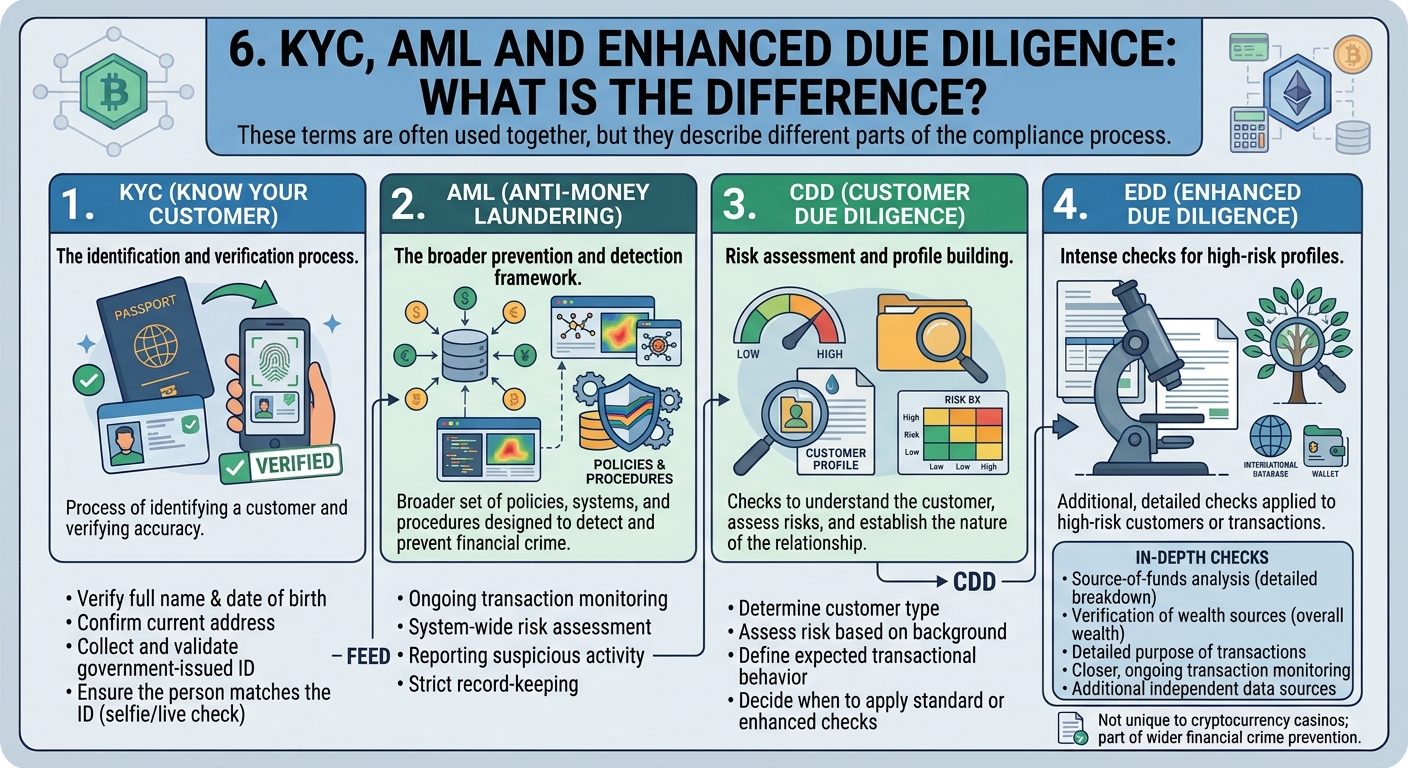
These terms are often used together, but they describe different parts of the compliance process.
KYC (Know Your Customer)
The process of identifying a customer and verifying that the information provided is accurate.
AML (Anti-Money Laundering)
The broader set of policies, monitoring systems, and procedures designed to prevent and detect money laundering and related financial crime.
CDD (Customer Due Diligence)
The checks used to understand who a customer is, assess relevant risks, and establish the nature of the business relationship.
EDD (Enhanced Due Diligence)
Additional checks applied when a customer or transaction presents a higher level of risk.
Enhanced due diligence may involve more detailed source-of-funds checks, questions about the purpose of transactions, additional independent verification, and closer monitoring.
These procedures are not unique to cryptocurrency casinos. They are part of wider financial crime prevention frameworks.
7. Can You Use a Crypto Casino Without KYC?
Some crypto casinos advertise registration or gameplay without immediate identity verification. However, this does not guarantee that the platform will never request documents.
A casino may allow account creation and deposits but require KYC before a withdrawal or when additional checks become necessary.
There is also an important distinction between a platform that does not request documents during registration and one that operates without any identity verification obligations.
Before using a platform, check:
- Whether KYC is required before the first withdrawal.
- Whether transaction or withdrawal limits apply.
- Whether additional verification can be requested later.
- Which countries the operator accepts.
- Which licence or regulatory framework applies.
- What happens if a customer cannot complete verification.
Never assume that a casino's marketing description overrides its terms and conditions or applicable law.
8. What Should You Check Before Submitting KYC Documents?
Identity documents contain sensitive personal information. Before uploading them, take a moment to assess the platform and its verification process.
Check the following:
- Official website: Make sure you are using the casino's genuine website, not a link from an unsolicited message.
- Licence information: Identify the operator and check the licence details where applicable.
- Privacy policy: Understand how personal information is collected, processed, stored, and shared.
- Verification provider: Check whether an external identity verification company is involved.
- Document requirements: Confirm which documents are accepted and whether they need to meet specific date or format requirements.
- Withdrawal policy: Read the rules concerning verification and withdrawals before depositing.
- Customer support: Make sure there is a reliable way to contact the operator if verification is delayed.
Do not send passport scans, identity documents, or financial statements to unofficial social media accounts or unknown email addresses.
Only provide information requested through the operator's official and secure verification process. Never share your wallet recovery phrase or private keys as part of KYC. A legitimate identity check should not require them.
9. What Happens If You Fail or Cannot Complete KYC?
If a verification attempt is unsuccessful, the casino may ask you to submit clearer documents or provide additional information.
Common reasons for delays or failed checks include:
- Expired identity documents.
- Blurry or incomplete photographs.
- Different personal details across documents.
- An address document that does not meet the operator's requirements.
- A selfie that cannot be matched to the identity document.
- Documents that cannot be independently verified.
- Missing information about a transaction or the origin of funds.
If you cannot complete verification, contact the operator through its official support channel and ask which requirement has not been satisfied.
Depending on the circumstances and applicable rules, the operator may restrict account activity or withdrawals while reviewing the case. The exact outcome depends on the operator's terms and legal obligations.
Keep copies of relevant communications and avoid creating additional accounts to get around a verification restriction.
10. Is KYC Safe at Crypto Casinos?
KYC can improve account security and help operators meet legal obligations, but submitting personal documents always involves privacy considerations.
A responsible operator should explain why it collects identity information and how that information is handled.
Players should look for clear privacy policies, secure upload procedures, and transparent information about third-party verification providers.
It is also worth remembering that no online system can guarantee absolute data security. The goal is to choose platforms that demonstrate responsible data handling and provide clear information about their compliance practices.
Frequently Asked Questions About Crypto Casino KYC
Do all crypto casinos require KYC?
No. Verification policies differ between operators and jurisdictions. Some request documents during registration, while others may ask for them before withdrawals or when additional checks are required.
Can a crypto casino request KYC after I have deposited?
Yes. A casino may request identity verification after registration or a deposit, particularly before processing a withdrawal or when its compliance procedures require further checks.
How long does crypto casino KYC take?
There is no standard processing time. Automated checks may be completed quickly, while manual reviews or requests for additional documents can take longer. Check the operator's published verification policy.
What is the most commonly requested KYC document?
A valid government-issued photo ID, such as a passport or national identity card, is commonly requested. Some operators also require proof of address or a selfie.
Why does a crypto casino ask for proof of funds?
The operator may need to understand the origin of deposited funds or assess a transaction under its anti-money laundering procedures. The documents requested depend on the circumstances and applicable rules.
Can I withdraw cryptocurrency before completing KYC?
That depends on the casino's policy and the legal requirements applicable to it. Some platforms allow withdrawals without an immediate document check, while others require verification before releasing funds.
Does using Bitcoin or another cryptocurrency avoid KYC?
No. Paying with cryptocurrency does not automatically remove an operator's identity verification obligations. A casino may still need to identify customers and monitor transactions.
Final Thoughts: Understand KYC Before Choosing a Crypto Casino
Crypto casino KYC is more than a registration form. It is part of a wider system designed to verify customer identities, reduce fraud, and meet anti-money laundering and gambling regulations.
The exact process depends on the operator, its licensing jurisdiction, the payment methods it supports, and the risk associated with a customer's activity.
For players, the most practical approach is to understand the verification policy before depositing, prepare valid documents if requested, and check how personal information is handled.
A casino that explains its KYC requirements clearly gives customers a better understanding of what to expect. Ultimately, knowing when identity verification may be required can help prevent unexpected withdrawal delays and support a safer online gambling experience.
Always check the laws applicable to your location and the terms of the specific operator before using a crypto casino.
---
Sources and Further Reading
Related Articles
The SHFL Lottery! $0.25 INTO $2000000
Will you be our next Jackpot winner?
How to Check If a Crypto Casino Is Legit and Safe
Is a crypto casino legit? Before depositing Bitcoin or other cryptocurrencies, learn how to verify gambling licences, identify the real operator, examine withdrawal rules, assess security features and check independent evidence of game fairness. This practical guide explains the warning signs every player should know.
$20,000 - ONU Luxe!
Hit a 500x multiplier to unlock rewards!