What Is a Provably Fair Casino? How to Verify Bets

Discover how provably fair casinos use cryptographic technology to make game results independently verifiable. Learn how server seeds, client seeds and nonces work together, how to verify individual bets, and what provably fair technology can—and cannot—guarantee.
What Is a Provably Fair Casino? How to Verify Bets
Online casinos often ask players to trust that every spin, dice roll, card draw or crash multiplier is generated fairly. But how can you check whether a result was actually produced according to the rules?
This is where a provably fair casino system comes in. Instead of asking players to rely entirely on the casino's word, provably fair technology uses cryptographic methods that allow individual game results to be independently checked.
The system is commonly built around three important components: a server seed, a client seed and a nonce. These values are combined using a cryptographic algorithm to generate game outcomes. After a round or seed rotation, players can use the revealed information to reproduce the calculation and check whether the result matches.
In this guide, we explain how provably fair technology works, what each component does, and how you can verify a bet yourself — even if you have never used a cryptographic verification tool before.
If you're new to cryptocurrency gambling, start with our beginner's guide, How Do Crypto Casinos Work? A Beginner's Guide, to understand how crypto wallets, blockchain transactions, deposits and withdrawals work before exploring provably fair technology.
What Does Provably Fair Mean?
A provably fair casino uses a cryptographic process that allows players to verify how a particular game result was generated.
In a conventional online casino, players generally see the outcome of a game but do not receive the underlying inputs needed to reproduce it. They must rely on the operator's software, independent testing, regulatory oversight and other trust mechanisms.
A provably fair system adds another layer of transparency. It gives players specific cryptographic values that can be checked after a game has finished.
The basic principle is simple:
- The casino generates a secret server seed.
- It publishes a cryptographic hash of that seed before the player places bets.
- The player's client seed and the bet's nonce are included in the outcome calculation.
- The game result is generated using a documented cryptographic algorithm.
- After the server seed is revealed, the player can check the original hash and reproduce the result.
This process is known as a commitment-and-reveal mechanism. The casino commits to a server seed in advance without exposing the secret itself. Later, the revealed seed can be compared with the original commitment.
The important point: a player does not need to guess whether the casino used the same server seed. The cryptographic commitment provides a way to check it.
The Three Main Components of a Provably Fair Casino
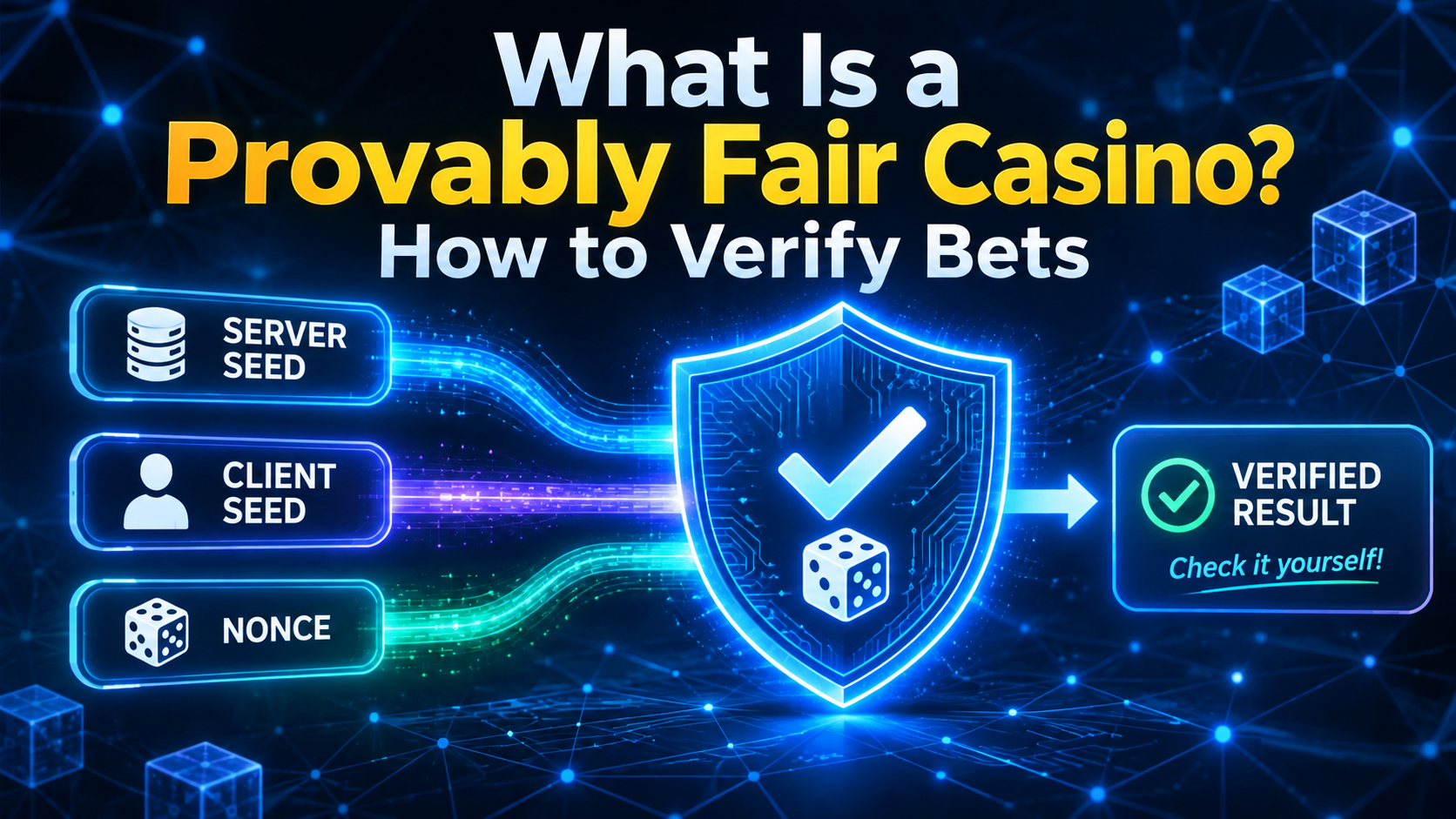
To understand how verification works, you first need to understand the three values used by most provably fair systems.
1. Server Seed: The Casino's Secret Input
The server seed is a randomly generated secret value created by the casino or game system.
It is one of the main inputs used to generate game outcomes. However, the casino does not normally reveal the original server seed before or during the relevant betting period.
Instead, it publishes a cryptographic hash of the server seed.
A hash is a fixed-length output produced by a cryptographic hash function. For example, SHA-256 produces a 256-bit hash, commonly displayed as a 64-character hexadecimal string.
The important distinction is that a hash is not encryption. It is designed to be practically infeasible to reverse and recover the original input.
Why does the casino publish the hash first?
Imagine that a casino generated a server seed, used it to produce several game results and then changed the seed after seeing those results.
Without an earlier commitment, players would have little way to identify that change.
Publishing the hash before betting creates a reference value. Once the original server seed is revealed, players can calculate its SHA-256 hash and compare it with the value published earlier.
If the hashes match, the revealed seed is consistent with the original commitment.
If they do not match, the verification has failed and the discrepancy should be investigated.
2. Client Seed: The Player's Input
The client seed is another value used in the result-generation process. It is usually generated automatically by the platform, although many casinos allow players to change it manually.
Unlike the server seed, the client seed is not intended to remain secret from the player. It represents the player's contribution to the calculation.
For example, a client seed might look like this:
`player-seed-2026-crypto`
This is only an illustrative example, not a real seed from a casino.
The client seed is combined with the server seed and nonce according to the platform's algorithm.
Why does the client seed matter?
If the result depended only on a secret controlled by the casino, the player would have no independent input into the calculation.
Including a client seed means that the outcome depends on both the casino's committed input and a player-side value.
Changing the client seed changes the resulting calculation. However, this does not mean that choosing a particular word, number or phrase can increase your chances of winning.
A client seed is not a betting strategy, a lucky number or a way to predict future outcomes. Its purpose is to contribute an additional input to the cryptographic process.
3. Nonce: The Unique Number for Each Bet
The nonce is a counter used to distinguish individual bets or game events.
The term comes from the expression "number used once". In a typical provably fair implementation, the nonce increases as new bets are made using the same server seed and client seed combination.
For example:
| Bet | Client Seed | Nonce |
|---|---|---|
| First bet | player-seed-2026-crypto | 0 |
| Second bet | player-seed-2026-crypto | 1 |
| Third bet | player-seed-2026-crypto | 2 |
| Fourth bet | player-seed-2026-crypto | 3 |
The exact starting value and increment rules depend on the casino's implementation.
Why is the nonce necessary?
Without a changing nonce or another unique input, using the same server seed and client seed repeatedly could produce the same cryptographic output.
The nonce makes each bet's input different, allowing the system to generate a different result from the same seed pair.
Some games also use additional values, such as a cursor or sub-nonce, to generate multiple random values within a single round. This is particularly relevant to games that need several random events, such as dealing cards.
How Do Server Seed, Client Seed and Nonce Work Together?
The three components are combined by a cryptographic algorithm to produce the data used for a game outcome.
One widely used approach is HMAC-SHA256.
HMAC stands for Hash-based Message Authentication Code. It uses a cryptographic hash function together with a secret key to produce a verifiable output.
In one common implementation, the server seed is used as the HMAC key, while the client seed and nonce form part of the message.
A simplified representation looks like this:
`HMACSHA256(serverseed, client_seed:nonce)`
For example:
- Server seed: `a7f3...` (illustrative)
- Client seed: `player-seed-2026-crypto`
- Nonce: `4`
The algorithm processes these inputs and produces a cryptographic output.
The game then converts that output into a result, such as a dice number, a crash multiplier or a set of card positions.
Important: this is a simplified illustration. Casinos do not all use exactly the same implementation. Some include a cursor, additional counters or game-specific conversion rules. The exact algorithm and conversion method must be documented by the casino if players are expected to reproduce its results.
What Is the Difference Between SHA-256 and HMAC-SHA256?
These two terms are often mentioned together in provably fair explanations, but they serve different purposes.
SHA-256 is a cryptographic hash function. It takes an input and produces a fixed-length hash. In many provably fair systems, it is used to create the published commitment to the hidden server seed.
HMAC-SHA256 is a keyed message authentication construction that uses SHA-256. In many implementations, it combines the server seed with the client seed and nonce to generate the data used for game outcomes.
In simple terms:
- SHA-256 helps the player check that the server seed was not changed after the casino committed to it.
- HMAC-SHA256 helps reproduce the random data generated from the server seed, client seed and nonce.
These are related but separate verification steps.
How to Verify a Provably Fair Casino Bet Yourself
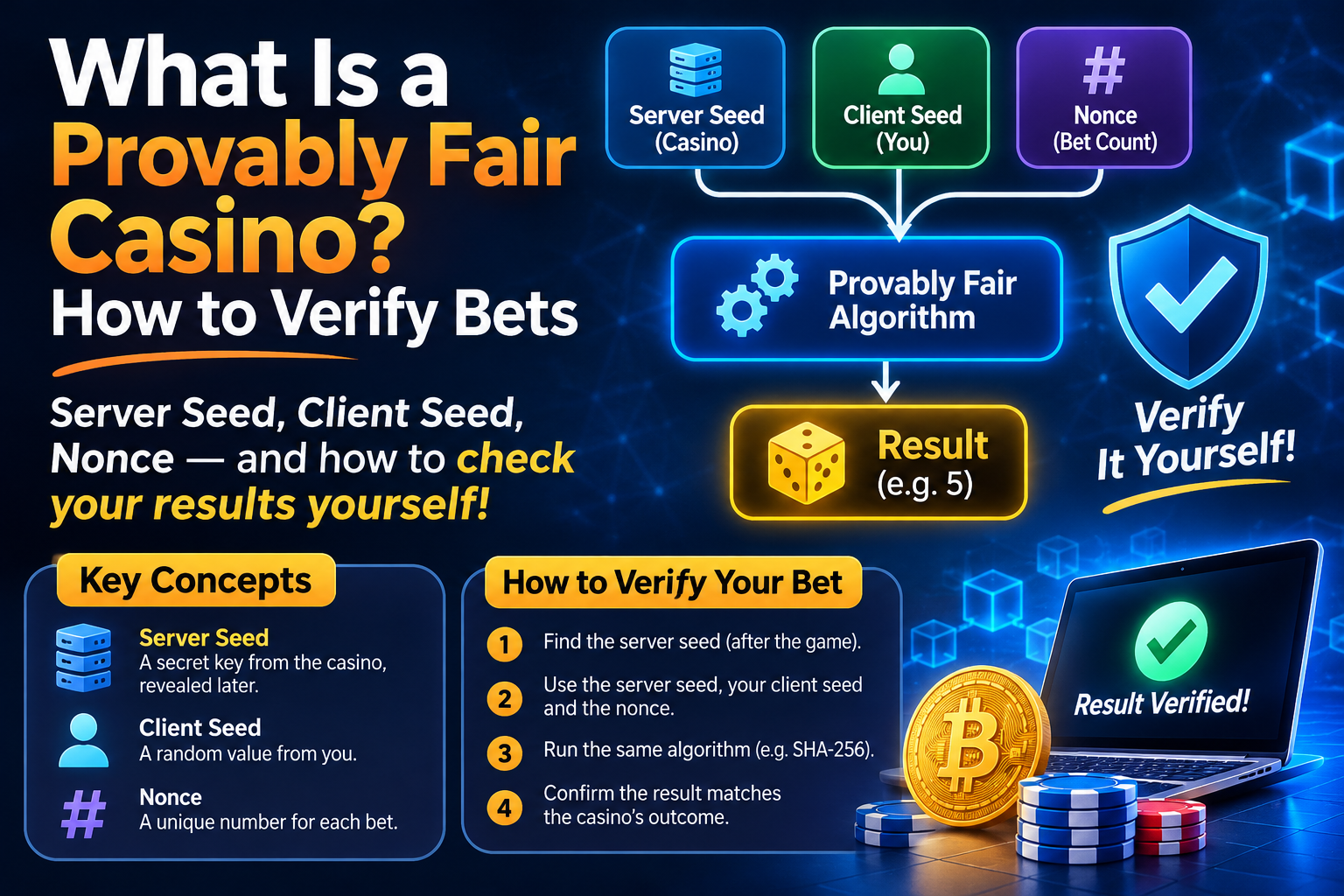
Understanding the theory is useful, but the real advantage of a provably fair casino is the ability to check an actual result.
The process usually takes only a few minutes.
Step 1: Find the Bet Details
Open your casino account and go to your betting history or recent game results.
Select the bet you want to verify.
Look for a section called one of the following:
- Provably Fair
- Fairness
- Game Verification
- Seeds
- Bet Details
The exact name and location depend on the casino.
You should be able to find the information associated with the bet, including the client seed, nonce and the server seed hash that was displayed before the game.
Keep a record of these details.
Step 2: Find the Original Server Seed Hash
Before a game or betting session begins, a provably fair casino should display the hashed server seed.
This is the commitment that you will use later.
For example:
`Published Server Seed Hash: 8f4c...`
The value above is illustrative.
Make sure you record the hash associated with the correct server seed and betting period. A hash from a different seed pair cannot be used to verify your bet.
Step 3: Reveal the Server Seed
After the relevant betting session, the casino should allow you to rotate your server seed or seed pair.
Rotation normally replaces the active server seed with a new one and reveals the previous server seed.
The exact process varies between platforms. Some casinos reveal the old seed automatically after rotation, while others provide it through the fairness settings.
Copy the revealed server seed.
Do not confuse it with the server seed hash. They are two different values:
- Server seed: the original secret value, revealed after rotation.
- Server seed hash: the cryptographic commitment published before the bets.
You need the actual revealed server seed for the verification process.
Step 4: Check the Server Seed Hash
Now use a SHA-256 calculator or the casino's own verification tool.
Enter the revealed server seed and calculate its SHA-256 hash.
Compare the result with the server seed hash you recorded before playing.
The two values should match exactly.
If they match, the revealed server seed is consistent with the earlier commitment.
If they do not match, check that you copied the correct values and used the correct text format. If the discrepancy remains, do not treat the bet as successfully verified.
Step 5: Recalculate the Game Result
The next step is to reproduce the original game result.
You will generally need:
- The revealed server seed.
- The client seed used for that bet.
- The exact nonce.
- The correct game type.
- The casino's documented algorithm and result-conversion rules.
Enter these values into the casino's official provably fair calculator or a suitable independent verifier that supports the same implementation.
The tool should reproduce the underlying random output and convert it into the game's result.
For example, if you played a dice game and the original result was 64.25, the verifier should produce the same value when given the correct inputs and algorithm.
If the result matches, you have independently reproduced that bet's outcome.
Step 6: Compare the Result With Your Bet History
The final step is to compare the calculated result with the original game record.
Check that:
- The server seed hash matches the original commitment.
- The client seed is identical to the one used for the bet.
- The nonce matches the bet history.
- The correct algorithm and game settings were selected.
- The calculated outcome matches the recorded result.
If all these checks pass, the result is consistent with the casino's published provably fair process.
A Simple Example: Verifying a Dice Bet
Imagine that you place a bet on a crypto casino dice game.
The game displays the following information:
| Verification Detail | Example Value |
|---|---|
| Game | Dice |
| Server Seed | Revealed after rotation |
| Server Seed Hash | Published before betting |
| Client Seed | `player-seed-example` |
| Nonce | `12` |
| Game Result | `64.25` |
These are fictional example values used to explain the process.
You first calculate the SHA-256 hash of the revealed server seed. You compare it with the server seed hash that was published before the bet.
Next, you enter the revealed server seed, client seed and nonce into a verifier configured for the casino's specific Dice implementation.
The verifier runs the same cryptographic calculation and applies the game's result-conversion rules.
If it produces `64.25`, matching the original game record, the result has been successfully reproduced.
If it produces a different number, do not immediately assume that the casino cheated. Check whether you selected the right game, used the correct nonce, copied the seed correctly and selected the right conversion method.
Even a small difference in the algorithm or input formatting can produce a completely different output.
Common Mistakes When Verifying Provably Fair Bets
Players sometimes receive a result that does not match their original bet. This does not automatically mean that the casino manipulated the outcome.
Several common mistakes can cause verification to fail.
Using the server seed hash instead of the revealed server seed
The hash is not the original seed. You need the revealed server seed to reproduce the game's calculation.
Using the wrong client seed
A player may have changed their client seed between betting sessions. Always use the client seed associated with the specific bet.
Entering the wrong nonce
Every bet has its own nonce. Using the previous or next number will normally produce a different result.
Selecting the wrong game algorithm
Different games can use different conversion methods, even if they share the same HMAC-SHA256 foundation.
Ignoring additional inputs
Some implementations use cursors, sub-nonces or other parameters to generate multiple outcomes within one game round. These values may be necessary for accurate verification.
Checking a different server seed period
If you have rotated your seed several times, make sure you are using the revealed seed that belongs to the bet you are checking.
The most reliable approach is to use the casino's documented implementation and compare every input carefully.
Does Provably Fair Mean a Casino Is 100% Safe?
No. This is one of the most important distinctions players should understand.
A provably fair system can provide strong evidence that a particular game result was generated using the committed server seed and the published algorithm.
However, it does not automatically prove that every aspect of the casino is fair, safe or trustworthy.
For example, provably fair verification does not necessarily establish:
- That the casino's random seed generation process is secure.
- That the casino's software has no other vulnerabilities.
- That the published game rules or payout calculations are correct.
- That the casino will process withdrawals fairly and on time.
- That the operator is properly licensed or financially reliable.
- That every third-party game on the platform uses the same provably fair system.
It is also important to understand that verifying a result does not guarantee a win.
A cryptographically verifiable game can still produce losing outcomes. Randomness does not mean that wins and losses must alternate or that a player is due for a winning result after a losing streak.
Provably fair technology is a transparency mechanism, not a winning strategy.
Provably Fair Casinos vs Traditional RNG Casinos
Both provably fair systems and conventional Random Number Generators (RNGs) can be used to generate unpredictable game outcomes.
The main difference is how players can examine the results.
| Feature | Provably Fair System | Traditional RNG System |
|---|---|---|
| Individual result verification | Often possible using seeds and a documented algorithm | Usually not through player-accessible seeds |
| Server seed commitment | Commonly uses a published hash | Not normally exposed to players |
| Player-controlled input | Often includes a client seed | Usually not available |
| Verification method | Recalculate the result using the published inputs | Typically relies on independent testing and certification |
| Transparency | Individual outcomes can be reproduced | Depends on testing, audits and operator disclosures |
This does not mean that traditional RNG casinos are automatically unfair. Reputable regulated casinos can use independently tested and certified RNG systems.
Likewise, the presence of a provably fair feature should not be treated as a complete substitute for licensing checks, security reviews or responsible gambling practices.
What Should You Look for in a Provably Fair Crypto Casino?
If you are evaluating a casino that advertises provably fair games, look beyond the marketing label.
A transparent platform should provide:
- A published server seed hash: You should be able to see the commitment before placing bets.
- A changeable client seed: Ideally, you should be able to set your own client seed.
- A clear nonce system: The casino should explain how the nonce changes between bets.
- A server seed reveal mechanism: Previous server seeds should become available for verification.
- A documented algorithm: The platform should explain how seeds are combined and how the result is calculated.
- A working verification tool: You should be able to reproduce results using the casino's calculator or a compatible independent tool.
- Clear game coverage: The casino should identify which games actually support its provably fair system.
Do not assume that every game on a crypto casino website is provably fair. Some platforms offer original games alongside titles supplied by external studios, which may use different verification and certification systems.
Always check the fairness information for the specific game you intend to play.
Frequently Asked Questions
What is a provably fair casino?
A provably fair casino uses cryptographic methods that allow players to independently check how individual game results were generated. The process commonly involves a server seed, client seed, nonce and a documented hashing algorithm.
Can a casino change its server seed after I place a bet?
A properly implemented commitment-and-reveal system is designed to prevent the operator from changing the committed server seed without detection. The player can compare the revealed seed's hash with the hash published before betting.
Can I choose my own client seed?
Many provably fair casinos allow players to change their client seed. Some generate one automatically. Changing it affects the calculation inputs, but it does not give you a reliable way to predict or improve future results.
What happens if my verification result does not match?
First, check the server seed, client seed, nonce, game selection and algorithm. Make sure you are using the actual revealed server seed rather than its hash. If everything is correct and the result still differs, save the bet details and contact the casino's support team.
Does provably fair mean I cannot lose?
No. Provably fair technology does not remove the house edge or guarantee winning outcomes. It allows you to check whether a result follows the stated cryptographic process.
Are all crypto casino games provably fair?
No. A casino may offer provably fair original games as well as third-party games that use different RNG systems. Always check the verification details for each individual title.
Is SHA-256 enough to verify a casino bet?
Not by itself. SHA-256 can be used to check the server seed commitment, but reproducing a game result usually requires the casino's full documented algorithm, including HMAC-SHA256 or other specified calculations and the game's conversion rules.
Final Thoughts: Transparency You Can Check Yourself
Provably fair technology gives crypto casino players something valuable: a way to examine individual game results instead of relying entirely on an operator's claims.
By understanding the server seed, client seed and nonce, players can learn how cryptographic inputs are combined and how a finished bet can be independently reproduced.
The most important habit is simple: do not just look for a "Provably Fair" label. Check whether the casino publishes its server seed commitment, reveals previous seeds, documents its algorithm and provides a working verification process.
A transparent system should make it possible for players to check the evidence themselves.
Remember: provably fair technology can improve transparency, but it does not guarantee profits, safe withdrawals or the overall reliability of a casino. Always research the operator, understand the risks and gamble responsibly.
---
Editorial note: Cryptographic implementations vary between casinos and games. The examples in this guide are illustrative; always use the exact algorithm and verification instructions published by the platform.
Sources and Further Reading
Related Articles
The SHFL Lottery! $0.25 INTO $2000000
Will you be our next Jackpot winner?
How to Check If a Crypto Casino Is Legit and Safe
Is a crypto casino legit? Before depositing Bitcoin or other cryptocurrencies, learn how to verify gambling licences, identify the real operator, examine withdrawal rules, assess security features and check independent evidence of game fairness. This practical guide explains the warning signs every player should know.
$20,000 - ONU Luxe!
Hit a 500x multiplier to unlock rewards!